
Building a CAD Pipeline with JSCAD, Swamp, and Claude
Disclaimer: The following text is an AI-generated summary of the design decisions and evolution of the JSCAD CAD generation system built with Swamp and Claude. All work was done iteratively with
claude-codehandling implementation while I approved steps and provided direction.
Choosing the Right CAD System
The starting question was simple: which free CAD system integrates best with Claude via Swamp?
We evaluated FreeCAD, CadQuery, OpenSCAD, JSCAD, OpenCascade, Blender, and LibreCAD. The key criteria were subprocess requirements, TypeScript support, and LLM-friendliness.
| System | Subprocess? | TypeScript? | LLM-friendly? |
|---|---|---|---|
| FreeCAD | Yes (Python) | No | Good |
| CadQuery | Yes (Python) | No | Excellent |
| OpenSCAD | Yes (CLI) | No | Excellent |
| JSCAD | No | Native | Good |
JSCAD won because it’s the only option that runs fully in-process inside a Swamp extension model. No subprocess, no Python, no temp files, no OS dependency.
The trade-off: CadQuery has better LLM research backing and outputs STEP natively. We accepted the loss of STEP to gain the in-process advantage.
Applying DDD to a CAD Domain
The initial instinct was to write a Swamp model with a run method that
evaluates a script string. But what are the actual domain concepts? CAD isn’t
naturally expressed in Swamp’s data model.
A ubiquitous language exercise surfaced these domain types:
| Raw concept | Domain type | Invariant |
|---|---|---|
| Script string | CadScript |
Non-empty, must define main() |
| Param map | ScriptParameters |
Immutable, defensive copy |
| JSCAD geometry | Geometry |
At least one shape |
| Output bytes | SerializedModel |
Carries format alongside bytes |
| Execution record | RenderResult |
Value object stored as Swamp resource |
All value objects — immutable, equality by value, no identity.
The domain services (ScriptEvaluator and GeometrySerializer) know nothing
about Swamp. The application layer (jscad_cad.ts) orchestrates them and owns
all Swamp I/O. Clean boundary between layers.
The new Function() Decision
How to evaluate user-provided JSCAD scripts safely inside the model?
Three options: subprocess deno eval (defeats the in-process advantage),
eval() directly (pollutes global scope), or new Function() with injected
scope.
We chose option 3:
new Function("primitives", "transforms", "booleans", ...,
  `${script}\nreturn main;`
)(primitives, transforms, booleans, ...)
Only the JSCAD modeling API is injected. No Deno, no fetch, no filesystem.
JSCAD scripts are code-as-data — the same pattern the JSCAD web editor uses.
One early bug: Claude wraps code in markdown fences (```javascript ```). We
added stripMarkdownFences() to ScriptEvaluator to strip before evaluation.
The Serializer Bug — 14KB of Zeros
Generated STL files were 14KB of pure zeros.
Initial hypothesis: boolean subtract produced empty geometry. Actual cause:
@jscad/stl-serializer returns ArrayBuffer[] not Uint8Array[] for binary
mode. Our mergeBuffers() called out.set(p, offset) where p was an
ArrayBuffer — TypedArray.set() silently writes zeros when given an
ArrayBuffer instead of a typed view.
The fix was one line:
const views = parts.map(p =>
  p instanceof Uint8Array ? p : new Uint8Array(p)
);
Lesson: npm package types lie. Verify actual runtime return types against source code, not the README.
The Validator as a Design Tool
The STL validator started as a way to catch bad output (zeros, degenerate triangles). It evolved into a design verification tool — the bounding box output told us exactly what was wrong with each model geometrically.
The checks evolved:
- v1: Is the file non-zero? Is the header count consistent with file size?
- v2: Are there degenerate triangles? What is the bounding box?
- v3 (slicer): What does it look like from all 6 sides vs reference?
The validator made the feedback loop tight enough to iterate rapidly. Without it, a bad model was just “wrong”. With it: “66mm wide, 75mm deep, should be 260mm — fix the handle.”
The LLM Generation Pattern
First attempt: call the Claude API directly inside the @jscad/cad model’s
generate method. Rejected immediately — violates Swamp’s design principle.
Models are execution units, not orchestrators.
Correct pattern: LLM generates the script at workflow level, passes it via CEL:
script: ${{ data.latest("jscad-script-gen", "result").attributes.stdout }}
Another bug found here: passing multi-line scripts via --input script=...
caused the shell to hang indefinitely. The shell couldn’t quote multi-line
strings safely. Fix: always write to a YAML input file first:
swamp model method run box-test run \
  --input-file /tmp/jscad-inputs.yaml \
  --json > /tmp/render-result.json 2>&1
The Skill as Institutional Memory
Every generation re-discovered the same JSCAD v2 API mistakes:
cube()doesn’t exist — usecuboid()center: true— must be[x, y, z]arraycylinder({length: 5})— useheight- Inline position math — parts protrude outside enclosures
The jscad-codegen skill encodes all of this with verified examples
cross-referenced against JSCAD source code. A references subfolder was added
after each bug with verified API docs and coordinate system rules.
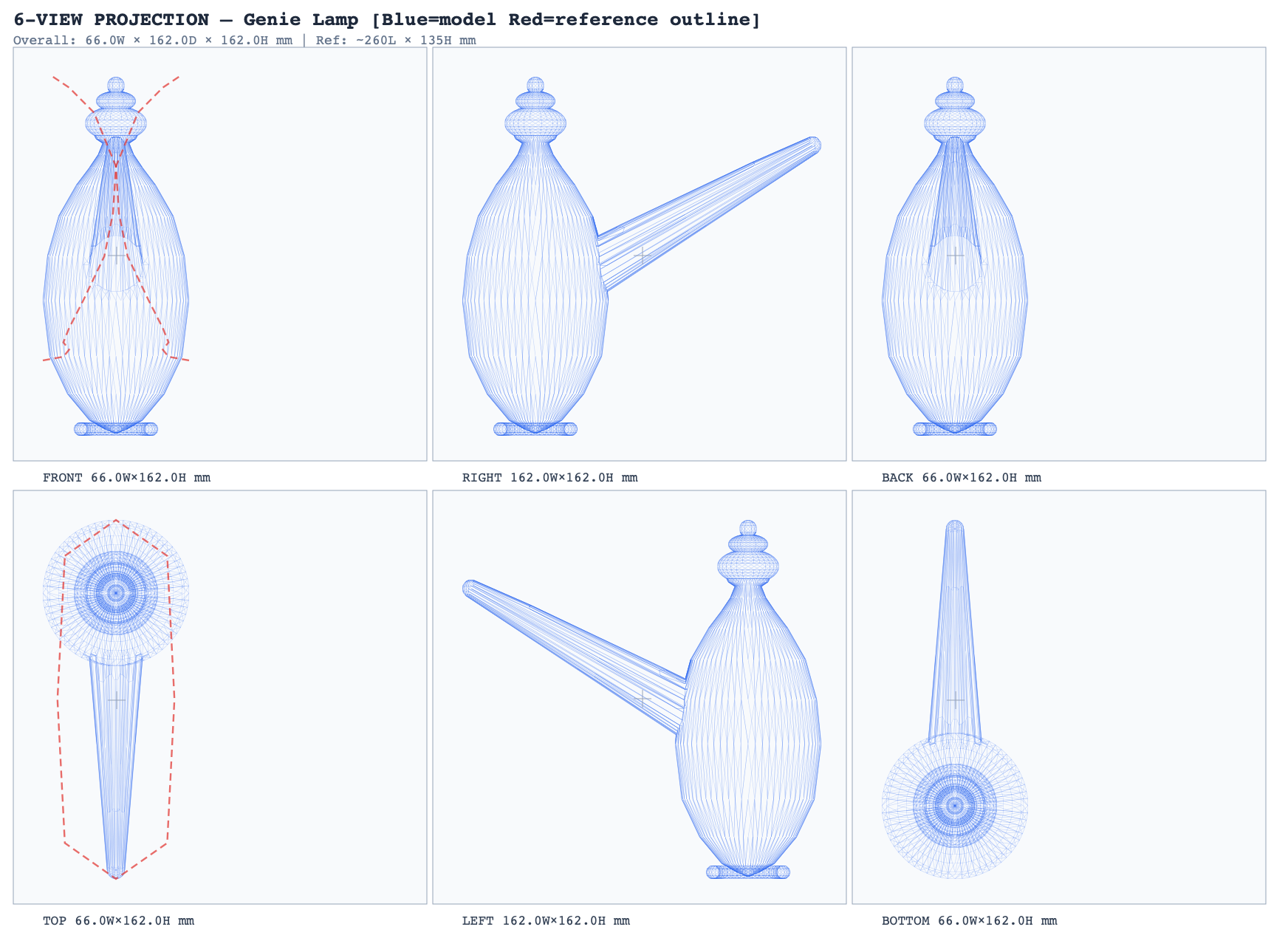
The 6-View Slicer as Ground Truth
“It looks wrong” isn’t actionable. We needed numbers from all angles.
The slicer was built as a Swamp extension model with two pure domain functions:
slice(bytes, z)— intersect triangles with a Z planesixViews(bytes)— project all edges onto 6 orthographic planes
It takes Uint8Array and returns SVG strings and measurements. No Swamp
knowledge in the domain service.
The 6-view layout:
Row 0:  FRONT  |  RIGHT  |  BACK
Row 1:  TOP    |  LEFT   |  BOTTOM
Red dashed outlines from reference proportions overlaid on blue model edges. Density of blue lines creates a natural silhouette — no convex hull computation needed.
Debugging the Genie Lamp
Three generations of bugs, all found by measurement not visual inspection:
Bug 1 — Scale: 75mm depth vs 260mm target. Body was a symmetric ellipsoid
blob. Fixed by switching to extrudeRotate of a hand-traced 2D profile and
hull() of tapering spheres for an organic spout.
Bug 2 — Handle orientation: rotate([deg(90), 0, 0], torus) rotates around
the X axis, putting the torus ring in the XZ plane (wrong). Fixed with
rotate([0, deg(90), 0], torus) to rotate around Y axis into the YZ plane.
Bug 3 — Translate/rotate order: translate followed by rotate moved the
translation offset onto the wrong axis. Fix: always rotate() first to align,
then translate() to position.
Design Principles That Emerged
| Principle | Origin |
|---|---|
| Domain services know nothing about Swamp | DDD applied upfront |
Static imports only — no dynamic import() |
Swamp bundler requirement |
| Write to input file, never inline in shell args | Shell hanging bug |
| Declare all coordinates as named constants upfront | HDD box ribs protruding |
rotate() before translate() when aligning an axis |
Genie lamp handle bug |
| Validate with numbers, not eyes | Every iteration |
| Throw before write — no partial data on failure | Swamp shell model pattern |
| LLM generates at workflow level, model only executes | Design review |